
From Competent to Credible: What Changes in How Senior Engineers Think
Introduction
Most early career civil engineers can’t remember the moment they first felt competent. It all of a sudden starts happening, other people start to come to you for answers and guidance. You can run calculations without panicking, your outputs have minimal comments after checking, and you understand how standards fit together. You are contributing and leading and not just guessing.
In UK civil and structural engineering, credibility develops through a shift in mindset rather than the passage of time alone. It reflects a deeper way of thinking about problems, risk, responsibility, and value. Senior engineers draw on experience to frame work more strategically, make decisions under uncertainty, and take ownership of outcomes that extend well beyond a single calculation.
This article explores what changes in thinking as engineers move from junior to senior roles, why this matters in real projects, and how early career engineers can begin developing this mindset as they work towards chartership and professional leadership.
Competence versus credibility in engineering practice
Competence is about technical capability. Can you analyse a beam, size a drainage system, or produce a compliant drawing under supervision. At junior level, competence is visible and measurable. It is demonstrated through correct use of standards, clear calculations, and responsiveness to comments.
Credibility is different. It is about judgement and trust. It is earned when others believe you will make the right call when the guidance is unclear, information is incomplete, or the consequences are serious. In the UK context, credibility underpins progression to independent responsibility and aligns closely with the expectations set out in the ICE attributes framework for Chartered Engineer status Institution of Civil Engineers.
Senior engineers are trusted not because they are always right, but because their thinking is defensible, proportionate, and aligned with safety, value, and long term outcomes.
1. From task execution to problem framing
How junior engineers think
Junior engineers are usually given a defined task. Check this retaining wall. Model this frame. Draft this drawing. Success is measured by solving the task as set and doing so correctly.
This focus is entirely appropriate early in a career. It builds technical foundations and discipline. However, it can also narrow thinking. The problem becomes the calculation rather than the outcome the calculation is meant to support.
How senior engineers think
Senior engineers start by questioning the brief. They ask what the client is really trying to achieve, what constraints matter most, and whether the current approach is the right one.
For example, rather than simply checking a foundation size, a senior engineer may ask whether the building layout could change to avoid poor ground, whether load paths can be simplified, or whether a different construction method would reduce programme risk.
This reframing often saves time and cost and reduces risk before design effort is wasted. It reflects a shift from task delivery to outcome ownership.
2. Judgement, risk, and the limits of standards
How junior engineers think
Early career engineers rely heavily on codes, software outputs, and precedent. This is sensible as standards provide a safety net and consistency, especially when experience is limited.
The danger comes when standards are treated as answers rather than tools. Software results are accepted without question, and unusual conditions cause uncertainty and indecision.
How senior engineers think
Senior engineers use standards as a baseline, not a crutch. They understand why rules exist, where they are conservative, and where they may not fully address real conditions and be applicable.
They think in terms of failure modes, uncertainties, construction tolerances, and human factors. When evidence is incomplete, they are able to apply judgement and document assumptions so that decisions remain defensible years later.
This is particularly important in safety critical design, temporary works, and assessments of existing assets and where reliable data may not exist.
3. Comfort with ambiguity and imperfect information
How junior engineers think
Ambiguity is uncomfortable early in a career. Missing surveys, conflicting comments, or unclear loads often lead to stalled progress while engineers wait for instruction or clarification.
How senior engineers think
Senior engineers accept ambiguity as normal. Rather than waiting, they create clarity by identifying what really matters, setting reasonable assumptions, and moving work forward in a controlled way.
They ask targeted questions, prioritise unknowns by risk, and record reasoning clearly. This allows progress without pretending certainty exists where it does not. Clients value this decisiveness because it reduces delay while still managing risk responsibly.
The truth is that all decisions are just best guesses.
4. From local detail to systems and lifecycle thinking
How junior engineers think
Junior thinking is often local. Does this beam work. Does this pipe have capacity. The focus is on individual elements within a single project phase.
Interfaces with other disciplines, future maintenance, or adjacent assets may not yet be fully appreciated.
How senior engineers think
Senior engineers see systems. They consider how elements interact across disciplines, how decisions affect construction sequencing, maintenance access, resilience, carbon, and cost over decades.
For example, drainage design is not just about meeting runoff rates. It affects adoptability, long term maintenance, climate resilience, and planning risk. A senior engineer weighs these trade offs explicitly.
This long view aligns closely with sustainability goals and the increasing emphasis on whole life value in UK infrastructure.
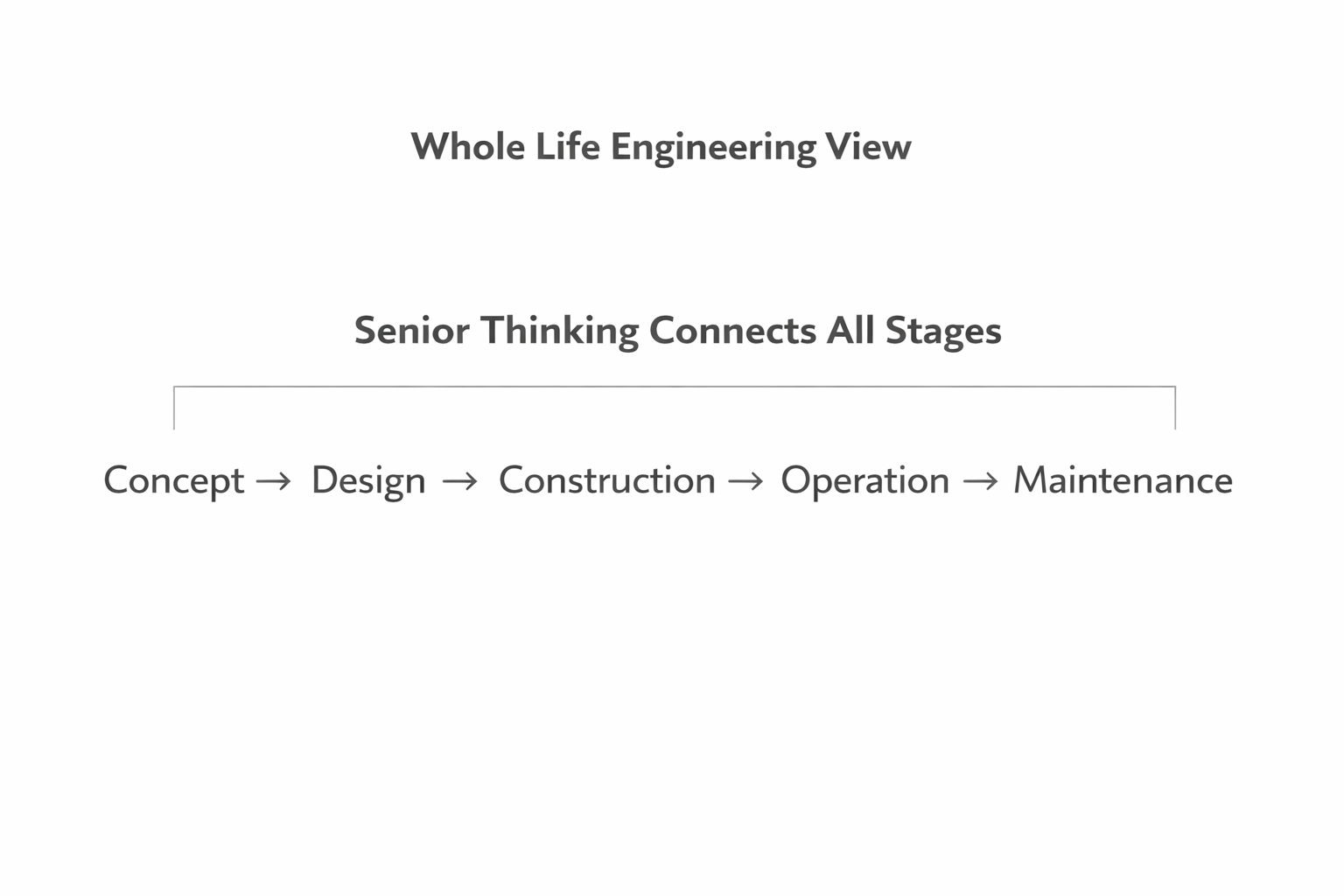
Whole life engineering view
5. Ownership, influence, and enabling others
How junior engineers think
Junior engineers expect work to be assigned. Success is delivering what is asked, on time and correctly. The end responsibility sits with someone else.
How senior engineers think
Senior engineers generate work by spotting risks and opportunities. They take ownership for packages, interfaces, or whole projects and think in terms of enabling others to succeed.
They consider how their decisions affect clients, contractors, regulators, and junior staff. They communicate clearly, mentor actively, and absorb pressure so that teams can function effectively.
This people centred thinking is a major part of why senior engineers are trusted with leadership roles.
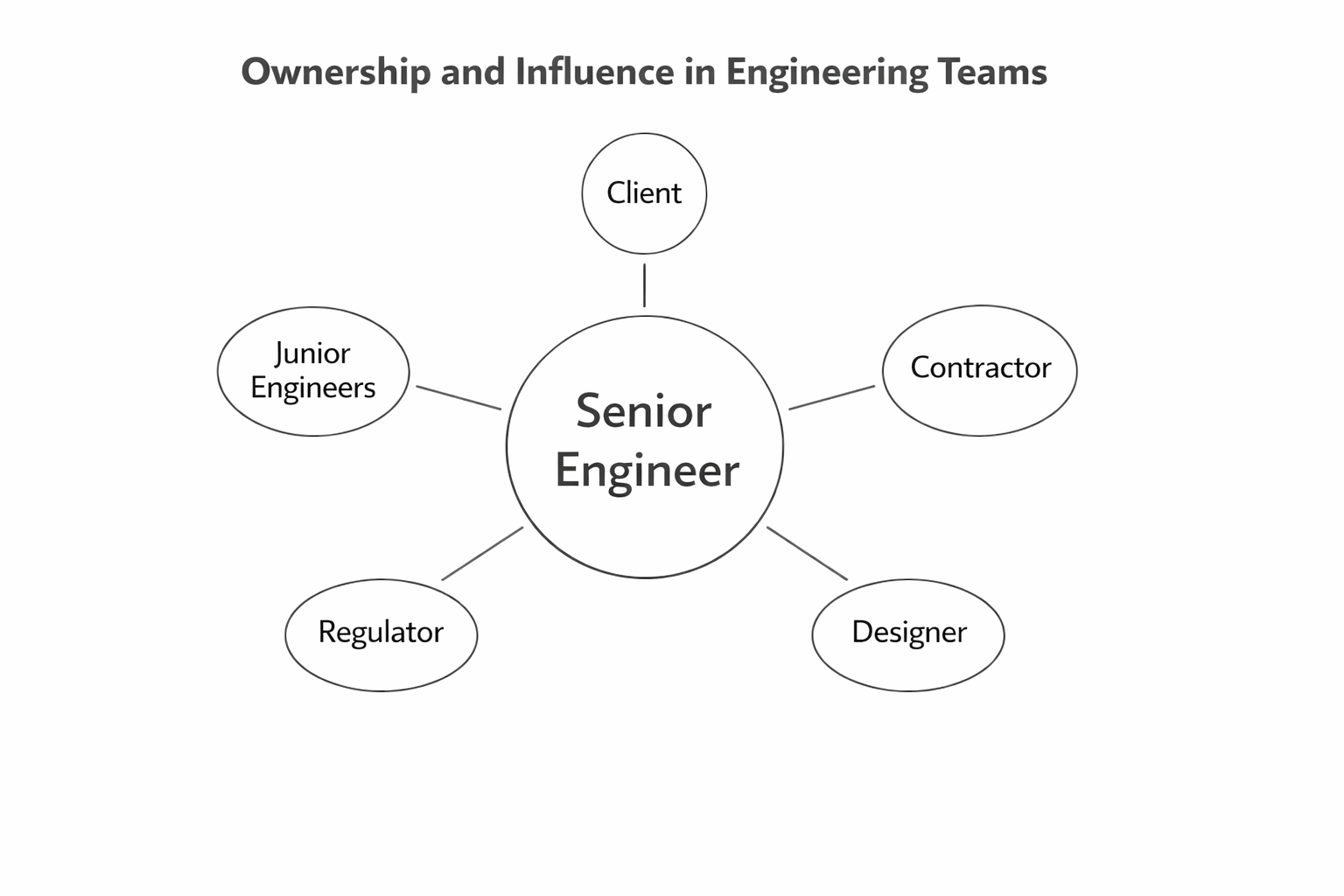
Ownership and Influence in Engineering teams
6. Credibility in the UK professional context
In the UK, the shift from competence to credibility aligns strongly with progression towards Chartered Engineer status through the ICE. At junior level, credibility comes from visible competence and development under supervision.
At senior level, credibility is demonstrated through independent judgement, ethical responsibility, and leadership. Reviewers for the Chartered Professional Review and clients look for evidence that an engineer can balance safety, value, sustainability, and uncertainty without close oversight.
This is why ICE attributes place such emphasis on judgement, responsibility, and communication rather than technical skill alone.
Developing senior thinking earlier in your career
You do not need a senior title to start thinking like a senior engineer. Practical steps include:
Asking why a task matters, not just how to do it
Considering risk and failure modes alongside calculations
Practising clear documentation of assumptions and decisions
Seeking exposure to site, construction, and operations
Reflecting on whole life impacts, not just compliance
These habits accelerate credibility and make chartership progression more natural and authentic.
Conclusion
The journey from competent to credible does not depend on mastering more equations or memorising additional standards. It rests on the way you approach problems, weigh judgement, and think through consequences.
Senior engineers frame problems, manage uncertainty, apply judgement, and take responsibility for outcomes that extend far beyond their own desk. They balance risk, value, and people, and they are trusted because their thinking is proportionate, transparent, and grounded in experience.
For early career engineers, understanding this shift early is powerful. It provides a clearer target for professional development and helps explain what assessors, clients, and leaders are really looking for.
If you want to stay sharp, informed, and inspired as you build credibility in your career, subscribe to the Civil Engineered for Success newsletter and explore our growing library of practical engineering insights.
Want more like this?
Explore other Civil Engineered for Success articles, share your thoughts in the comments, connect with the CEFS community, and subscribe to the newsletter for regular insight on building a credible and resilient engineering career.
References
ScienceDirect, Engineering Judgement
https://www.sciencedirect.com/topics/engineering/engineering-judgement
Krunal Parmar, LinkedIn Post on Senior Engineer Thinking
https://www.linkedin.com/posts/krunal-parmar-13a34a8b_seniorengineer-careerprogression-techlead-activity-7342820129421836288-9m7N
Formation.dev, What Senior Engineers Do Differently
https://formation.dev/blog/what-senior-engineers-do-differently-with-ai-to-maximize-impact/
City University London, Expert Judgement in Engineering
https://staff.city.ac.uk/~sm377/ls.papers/ExpJudgeReport/ExpJudgeReport96.pdf
[9] Prospects, Consulting Civil Engineer Profile
https://www.prospects.ac.uk/job-profiles/consulting-civil-engineer
Burns Sheehan, Hiring Senior vs Mid Level Engineers
https://www.burnssheehan.co.uk/blog/what-to-look-for-when-hiring-senior-vs-midlevel-software-engineers/bp1586/
ICE, How to Become a Professionally Qualified Engineer
https://www.ice.org.uk/your-career/how-to-become-a-professionally-qualified-engineer
ICE, Professional Qualifications Guidance
https://www.ice.org.uk/your-career/how-to-become-a-professionally-qualified-engineer/professional-qualifications