
Lifecycle Thinking for Ordinary Projects, Not Flagship Schemes or Megaprojects
Lifecycle Thinking for Ordinary Projects, Not Flagship Schemes
Most civil engineering work takes place away from major national programmes. It involves drainage repairs, retaining walls, highway improvements, culvert replacements, small bridges, pumping stations, flood measures and routine asset renewal.
Each individual project may be modest. Across an organisation or network, the combined effect of these decisions is substantial. They influence maintenance budgets, carbon emissions, public disruption, operational risk and the reliability of infrastructure for many years.
Lifecycle thinking provides a practical way to improve these decisions. It considers the service that an intervention must provide, the assets needed to deliver it, and the consequences of constructing, operating, maintaining, adapting and eventually replacing or removing those assets.
The analysis should reflect the scale and consequence of the project. A local drainage repair rarely needs a detailed life-cycle assessment. It still needs a clear record of the options considered, the likely maintenance requirements, future conditions, ownership and the main whole-life costs and impacts.
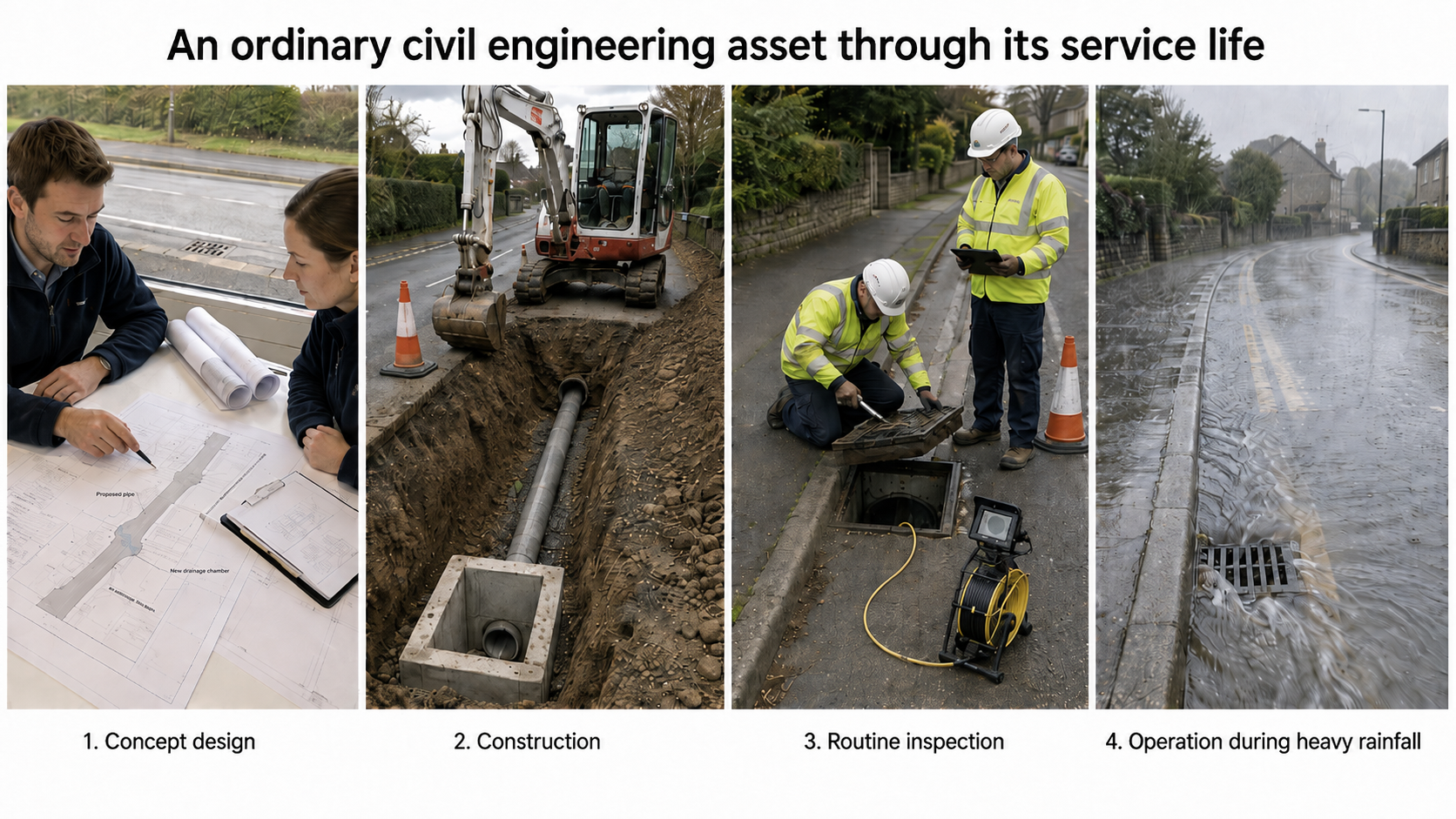
An ordinary civil engineering asset through its service life
What lifecycle thinking means
Lifecycle thinking starts with the service that infrastructure must provide.
A culvert provides hydraulic conveyance. A retaining wall supports ground and protects nearby infrastructure. A pumping station moves water at a required rate and reliability. A flood embankment reduces the probability and consequences of flooding.
The physical asset is one possible means of providing that service. This distinction matters because it leaves room to consider repair, maintenance, operational changes, demand reduction, nature-based measures and new construction.
Lifecycle thinking normally considers:
capital, operating, maintenance and renewal costs
embodied and operational carbon
construction safety, buildability and disruption
inspection access and maintainability
asset deterioration and failure
resilience to future conditions
environmental and social effects
adaptation, reuse and eventual decommissioning
A formal life-cycle assessment can support this work by examining environmental impacts associated with materials, energy and processes. Lifecycle thinking covers additional questions about performance, affordability, risk, ownership and future service requirements.
This approach is reflected in several UK frameworks. PAS 2080:2023 covers whole-life carbon across the provision, operation, use and end of life of buildings and infrastructure. ISO 55001:2024 provides a wider asset-management framework for balancing performance, risk and expenditure.
HM Treasury’s Green Book requires the costs, benefits and risks of different options to be assessed when public bodies are deciding how to achieve an objective. The same basic principle is useful on private projects, even where a formal Green Book appraisal is unnecessary.
Why ordinary projects deserve attention
Small projects can create long obligations.
A short length of drainage pipe may require repeated cleansing, traffic management and confined-space access. A small pumping installation may use energy every day and need several mechanical and electrical replacements during the life of the civil structure. A swale may use relatively few construction materials, while its performance depends on vegetation management, sediment removal and a clearly identified maintainer.
Standard details can also have a cumulative effect. A poorly positioned inspection chamber may be manageable on one site. Repeating the same arrangement across a network can create years of avoidable maintenance difficulty.
Lifecycle thinking therefore has value wherever a design decision affects future performance, cost or risk. The level of investigation can remain proportionate.
For a routine intervention, the project team may only need:
a short comparison of credible options
indicative capital and maintenance costs
a basic carbon comparison
a check against future loading or climate conditions
a named asset owner and maintainer
clear inspection and handover requirements
More analysis is justified where failure would have serious consequences, environmental interactions are complex or future conditions are highly uncertain.
Define the service before selecting the asset
A useful project brief describes the outcome required while leaving the physical solution open.
Consider a location that experiences regular surface-water flooding. A brief that states “install a larger pipe” has already restricted the option appraisal. A service-based objective could be:
Reduce surface-water flood risk at the low point under current and future rainfall conditions, while providing an affordable and maintainable solution.
That objective allows the team to consider several approaches:
Clean, repair or re-line the existing pipe.
Remove a local hydraulic restriction.
Reduce the amount of runoff entering the system.
Introduce upstream storage or sustainable drainage.
Improve the surface exceedance route.
Increase the capacity of the existing system.
Combine several smaller interventions.
The Environment Agency’s flood and coastal erosion risk management appraisal guidance follows this objectives-and-options approach. It also expects the depth of appraisal to be proportionate to the project.
A genuine do-minimum option should remain in the comparison. It establishes what would happen if the organisation continued with essential maintenance and limited intervention.
The do-minimum case must include realistic costs and consequences. If the existing asset would need frequent emergency repairs, road closures or reactive cleansing, those requirements belong in the baseline. Leaving them out can make continued maintenance appear artificially inexpensive.
Five questions that shape whole-life value
1. Can the required service be provided with less construction?
The greatest opportunity to reduce cost, carbon and disruption often exists before the preferred solution has been selected.
The whole-life carbon hierarchy associated with PAS 2080 encourages teams to consider whether construction can be avoided, whether less infrastructure could provide the service, and whether the design can be improved before concentrating on construction efficiency.
For a culvert project, targeted repair and upstream runoff management may deserve consideration before full replacement. For a retaining wall, local strengthening, drainage improvements or changes to the supported area could be compared with complete reconstruction.
The 2026 NISTA Whole Life Carbon Management Handbook reinforces the value of considering whole-life carbon at the early project stages, while the ability to influence the outcome remains high.
2. Which costs will continue after construction?
The construction contract represents only part of the financial commitment.
Whole-life costs may include:
routine inspections
cleaning and vegetation management
energy consumption
replacement components
traffic management
land access
reactive repairs
periodic renewal
monitoring
eventual removal or decommissioning
Early estimates will contain uncertainty. Sensible ranges are often more useful than a single precise figure. The project team can test whether the preferred option changes when cleaning frequency, energy use, replacement intervals or access costs vary.
Formal public-sector appraisal may require discounted present-value calculations. A simple comparison of recurring costs can still improve a smaller design decision.
3. Can the asset be maintained safely?
Maintainability should be visible in the design.
Engineers should consider whether operatives can reach inspection points, isolate equipment, remove sediment, control water, replace components and work safely. Regular lane closures, confined-space entry or specialist lifting equipment may dominate the operating cost of an apparently simple asset.
Ownership must be considered alongside physical access. A technically sound drainage feature may decline where no organisation has accepted responsibility for inspection and maintenance.
England’s 2025 National Standards for Sustainable Drainage Systems include a specific standard covering construction, operation, maintenance, decommissioning and structural integrity. This places long-term management within the design process.
The Environment Agency’s flood asset guidance also establishes common good practice for inspection, maintenance and condition grading. It shows how routine asset information can support risk-based intervention.
4. How could future conditions change?
A nominal design life does not mean that every component will remain unchanged throughout that period.
Rainfall, temperature, traffic, catchment development, water demand and operational requirements may alter. Materials and components also deteriorate at different rates.
Engineers can respond by testing several credible futures and identifying adaptation triggers. A drainage scheme might preserve space for future storage, include a safe exceedance route and identify the evidence that would trigger further work. A pumping station might provide room for an additional pump or allow controls to be replaced without major civil alterations.
The Environment Agency’s climate guidance supports adaptive approaches to future flood risk. It recognises that flexibility can have value where future conditions are uncertain.
This does not require every scheme to be oversized immediately. A modest initial intervention may provide better whole-life value where future expansion is practical and the trigger for expansion is clearly defined.
5. Which wider outcomes could influence the choice?
Ordinary projects can affect water quality, biodiversity, amenity, accessibility, noise, local disruption and community resilience.
These outcomes should enter the option appraisal while the design can still respond to them. Considering biodiversity after a concrete drainage layout has been fixed leaves limited opportunity to change the character of the scheme.
Some effects can be valued in monetary terms. Others are better recorded through quantities, scores or clear qualitative evidence. Defra’s Enabling a Natural Capital Approach guidance supports the use of monetary and non-monetary information within appraisal.
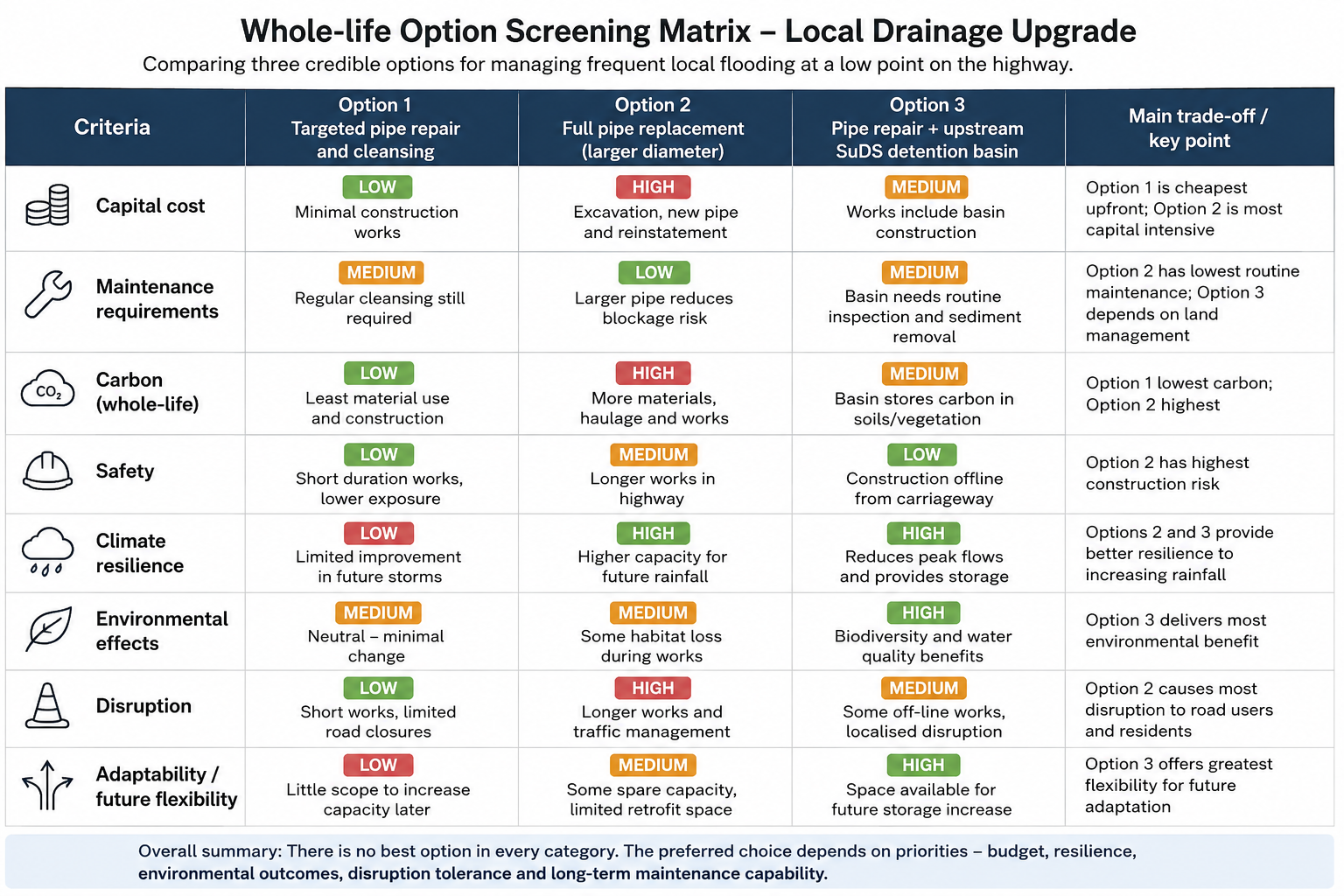
Whole-life option screening matrix
A proportionate project workflow
Lifecycle thinking can be incorporated into normal project gateways.
1. Define the service and system boundary
Record the required outcome, the beneficiaries, the intended service period and the connected assets or systems that could be affected.
For drainage work, the boundary may include upstream runoff, downstream capacity, highway drainage, sewers, watercourses and surface exceedance routes. Looking at one pipe in isolation can transfer risk elsewhere.
2. Develop materially different options
Include repair, maintenance, operational change and demand reduction where they are credible. A longlist containing several versions of the same structure provides limited choice.
Combinations may be useful. A smaller conventional intervention could work with source control, property-level measures or nature-based features.
3. Identify the dominant lifecycle drivers
Focus effort on the matters capable of changing the decision.
These might include concrete and steel quantities, pumping energy, traffic management, dewatering, sediment removal, mechanical replacement, land agreements or access constraints.
4. Record assumptions and trade-offs
Use a short decision register or options table. Record the evidence used, major uncertainties and reasons for rejecting each option.
Future engineers should be able to understand why the selected solution was considered appropriate. This becomes particularly important when climate assumptions, maintenance budgets or ownership arrangements change.
5. Convert lifecycle assumptions into design requirements
Drawings and specifications should provide inspection access, isolation points, component replacement routes and safe maintenance areas.
The design should also define acceptable deterioration, likely replacement intervals and the response to exceedance or partial failure.
6. Commission and hand over the service
Commissioning should confirm that the intended service has been achieved.
For drainage, this may include checking hydraulic connectivity, flow-control settings, infiltration performance and exceedance routes. For mechanical assets, it may include duty testing, alarms, controls and standby arrangements.
The asset owner should receive as-built information, design assumptions, inspection requirements, cleaning frequencies, replacement intervals, adaptation triggers and the location of the project records.
Monitoring should have a clear purpose. Routine inspections and observations after significant events may provide more value than an extensive sensor system without agreed intervention thresholds.
A compact lifecycle record can consist of a service brief, an options register, a whole-life value sheet, an ownership and maintenance plan, adaptation triggers and a commissioning record.
Worked example: a local drainage upgrade
Consider a road that floods several times each year near a low point. A CCTV survey identifies displaced pipe joints and sediment. Restoring the pipe would improve its condition, although future rainfall may place greater demand on the system.
The project team compares three options.
Targeted repair and cleansing
This has a low capital cost and limited construction impact. It retains sensitivity to future rainfall and may require regular maintenance.
Full replacement with a larger pipe
This improves conveyance and may reduce the need for major civil work for many years. It requires more material, excavation, traffic management and embodied carbon.
Targeted repair with upstream storage or SuDS
This reduces the inflow reaching the pipe and may provide water-quality, habitat or amenity benefits. It depends on land availability, landscape maintenance and clear ownership.
A lifecycle comparison would examine flood performance, road closures, maintenance access, carbon, land agreements, environmental effects and future adaptation.
The preferred solution could be staged. The existing pipe might be repaired, upstream runoff reduced and a route retained for later enlargement. The appropriate choice would depend on site evidence, costs and confirmed maintenance arrangements.
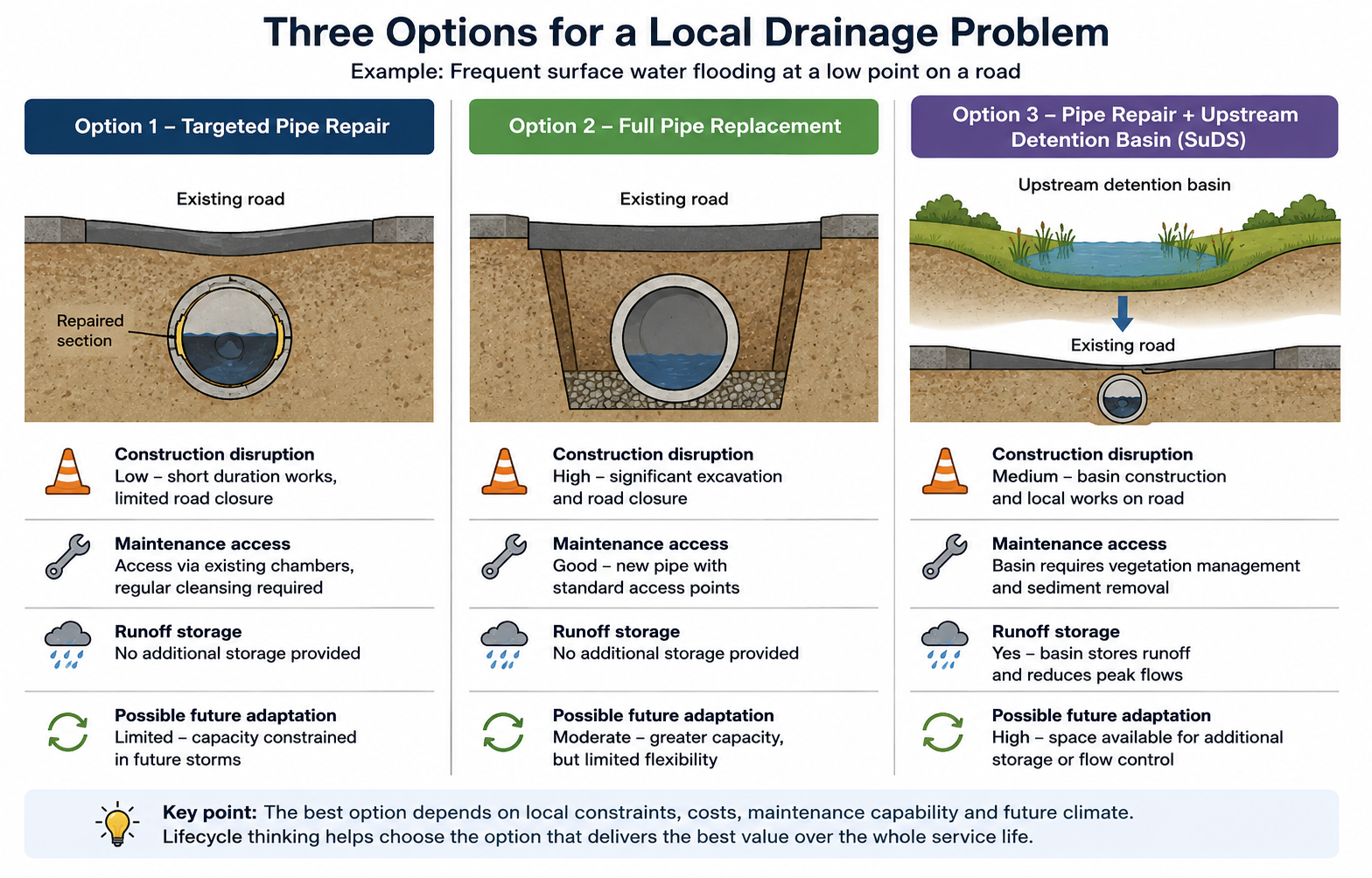
Three options for a local drainage problem
Common failure points
Lifecycle decisions are weakened when:
a physical solution is fixed before the service need is properly defined
maintenance responsibility remains unresolved until handover
carbon is calculated after the principal quantities are fixed
design life is treated as a period requiring no intervention
environmental outcomes are considered only during mitigation
future conditions are represented by one fixed forecast
monitoring data has no agreed decision or response attached to it
important assumptions disappear between appraisal, design and operation
Before construction, the project team should be able to identify the owner, operator and maintainer. It should also understand the main failure routes, maintenance requirements, residual risks and circumstances that would trigger adaptation.
Conclusion
Lifecycle thinking belongs in routine civil engineering.
For an ordinary project, the process can remain compact. Define the required service, compare genuinely different options, consider recurring cost and carbon, confirm ownership, design for maintenance, allow for future change and preserve the information needed by the asset manager.
The quality of the decision matters more than the length of the assessment.
A project can meet its construction budget while creating years of avoidable maintenance, disruption and risk. Early lifecycle thinking gives engineers a better chance of delivering infrastructure that remains safe, affordable and useful as conditions change.
Continue the discussion
Explore our other civil engineering articles for more practical guidance, and share in the comments how lifecycle considerations have influenced one of your projects.
References
National Infrastructure and Service Transformation Authority,Whole Life Carbon Management, 2026.
British Standards Institution,PAS 2080:2023 Carbon Management in Buildings and Infrastructure.
International Organization for Standardization,ISO 55001:2024 Asset Management Systems.
HM Treasury,The Green Book 2026.
Environment Agency,Flood and Coastal Erosion Risk Management Appraisal Guidance.
Department for Environment, Food and Rural Affairs,National Standards for Sustainable Drainage Systems, 2025.
Environment Agency,Flood Risk Asset Maintenance and Inspection Good Practice Guidance.
Department for Environment, Food and Rural Affairs,Enabling a Natural Capital Approach, 2026.
Flanagan, R.,Whole-life Thinking and Engineering the Future, Frontiers of Engineering Management, 2014.