
Designing Infrastructure for People You Will Never Meet
Most civil engineers will never meet the people who rely on their work.
A drainage engineer may never meet the family whose home stays dry during a storm twenty years later. A structural engineer may never meet the resident who sleeps comfortably because vibration was properly assessed. A temporary works designer may never meet the construction worker whose access platform, lifting frame or support system helped them return home safely. A stadium engineer may never meet the visitor who moves through a crowded concourse without fear, confusion or delay.
Civil engineering carries this quiet responsibility. Much of the profession is built around decisions made for strangers.
That distance gives the work its professional weight. Engineers make decisions for people who may never know their names, but whose safety, comfort and quality of life depend on the care taken in design, construction and operation.
This is one of the reasons civil engineering is important, the work sits behind daily life. It supports homes, roads, railways, water systems, public spaces, energy networks, schools, hospitals, stadiums and flood defences. Most users and members of the public will never see the calculations, drawings, specifications, design reviews or risk assessments that shaped the asset. They will simply experience whether it works.
For engineers and those working towards chartership and even fellowship, this is a useful way to understand professional competence. The ICE attributes are not a paperwork exercise. They ask whether an engineer can apply knowledge responsibly, manage risk, communicate clearly, act ethically and make decisions in the public interest.
Designing infrastructure for people you will never meet requires technical skill. It also requires judgement, discipline and empathy. The engineer must think about people beyond the client, beyond the design team and beyond the immediate construction phase.
This article explores that idea through four areas of civil engineering practice: stadiums and legacy infrastructure, vibration and residential comfort, SuDS and water infrastructure, and the detailed work behind major projects such as Hinkley Point C and Sizewell C.
The common theme is simple. Infrastructure must serve people beyond the design meeting.
Civil Engineering Is Public Service Through Technical Detail
Every civil engineering project contains a public promise.
A bridge promises safe passage. A drainage system promises controlled water management. A power station promises long-term energy supply. A stadium promises safe assembly. A residential structure promises stability, comfort and protection. A public realm scheme promises access, movement and amenity.
The public usually experiences the promise rather than the process.
They do not see the early feasibility studies, design assumptions, temporary works checks, ground models, design risk assessments, value engineering exercises, maintenance reviews or construction sequencing workshops. They see the final asset. They walk across it, live beside it, sit inside it, travel through it or depend on it during difficult weather.
That is why detail matters.
A small error in a drainage detail can affect downstream flood risk. Poorly considered maintenance access can cause long-term failure. Weak coordination between disciplines can leave hidden operational problems. A lack of inclusive thinking can make public infrastructure difficult or unsafe for some users. A missed vibration issue can affect someone’s home life for years.
Civil engineering decisions last. They often outlive the design team, the contractor, the original client and the political context that created the project.
This is why robust design matters. It should be based on sound guidance, carefully considered assumptions, clear communication and proper understanding of how the asset will be used. Good infrastructure should be safe, buildable, maintainable and useful. It should work for the people who will inherit it.
For engineers, this is an important professional step. Technical tasks can sometimes feel narrow, a calculation, drawing mark-up, inspection note, drainage sketch or temporary works query may seem like a small contribution. But, in reality, those tasks form part of a wider system of public protection.
Competence grows when an engineer understands the human purpose behind the technical task.
Stadiums: Designing for Crowds, Legacy and Future Communities
A major stadium may hold tens of thousands of visitors. Many arrive unfamiliar with the site. Some are with children. Some have mobility impairments. Some are anxious in crowds. Some are excited, distracted or tired. Some arrive by train, some by coach, some on foot, and some need step-free access. All of them depend on the design.
The public experience of a stadium is shaped by engineering decisions.
Sightlines, seating geometry, vibration, access routes, concourse widths, stairs, ramps, evacuation routes, crowd flow, lighting, drainage, public transport connections and emergency planning all affect whether the venue works. These issues are not secondary to the architecture. They are central to the safety and usefulness of the asset.
The London 2012 Olympic and Paralympic Games provide a strong example of infrastructure designed with legacy in mind. The Olympic Park in Stratford was developed on a large brownfield site in east London. The project involved remediation, new venues, bridges, utilities, transport links, public realm and long-term regeneration. The Institution of Civil Engineers describes the Games as a major civil engineering project that transformed the Lower Lea Valley and created lasting infrastructure for east London.
The key lesson from London 2012 is the importance of designing for more than opening day.
The Olympic Park had to function during the Games, when huge numbers of spectators, athletes, staff and media moved through the site. It also had to become a lasting part of the city. This required a careful balance between temporary and permanent infrastructure.
Some venues handled this transition well.
The Aquatics Centre was used as a high-capacity Olympic venue during the Games. Temporary seating wings were added for the event and later removed. The building then became a public swimming facility for long-term community use. That approach gave the Games the capacity they required while leaving a more suitable permanent asset behind.
The Velodrome also stands out as a strong legacy venue. Its compact form, efficient structure and clear long-term purpose allowed it to continue as a cycling venue after the Games. The design did not rely on a vague future use. Its future use was central to the brief.
The Olympic Stadium provides a more difficult lesson. The original design included a permanent lower bowl and temporary upper seating, with a reduced capacity legacy concept. Later conversion for football created significant challenges because the stadium geometry, running track, sightlines and operational requirements were not originally aligned with the needs of a conventional football ground. Many news stories have highlighted the cost and complexity of the later conversion, particularly around retractable seating and long-term operation.
For engineers, this matters because legacy design must be tested honestly. A future use should not be treated as a loose aspiration. Legacy design needs proper engineering, commercial and operational analysis from the start.
The people who use a stadium after the event are just as important as those who attend during the opening fortnight. A successful legacy asset needs to work physically, financially and socially.
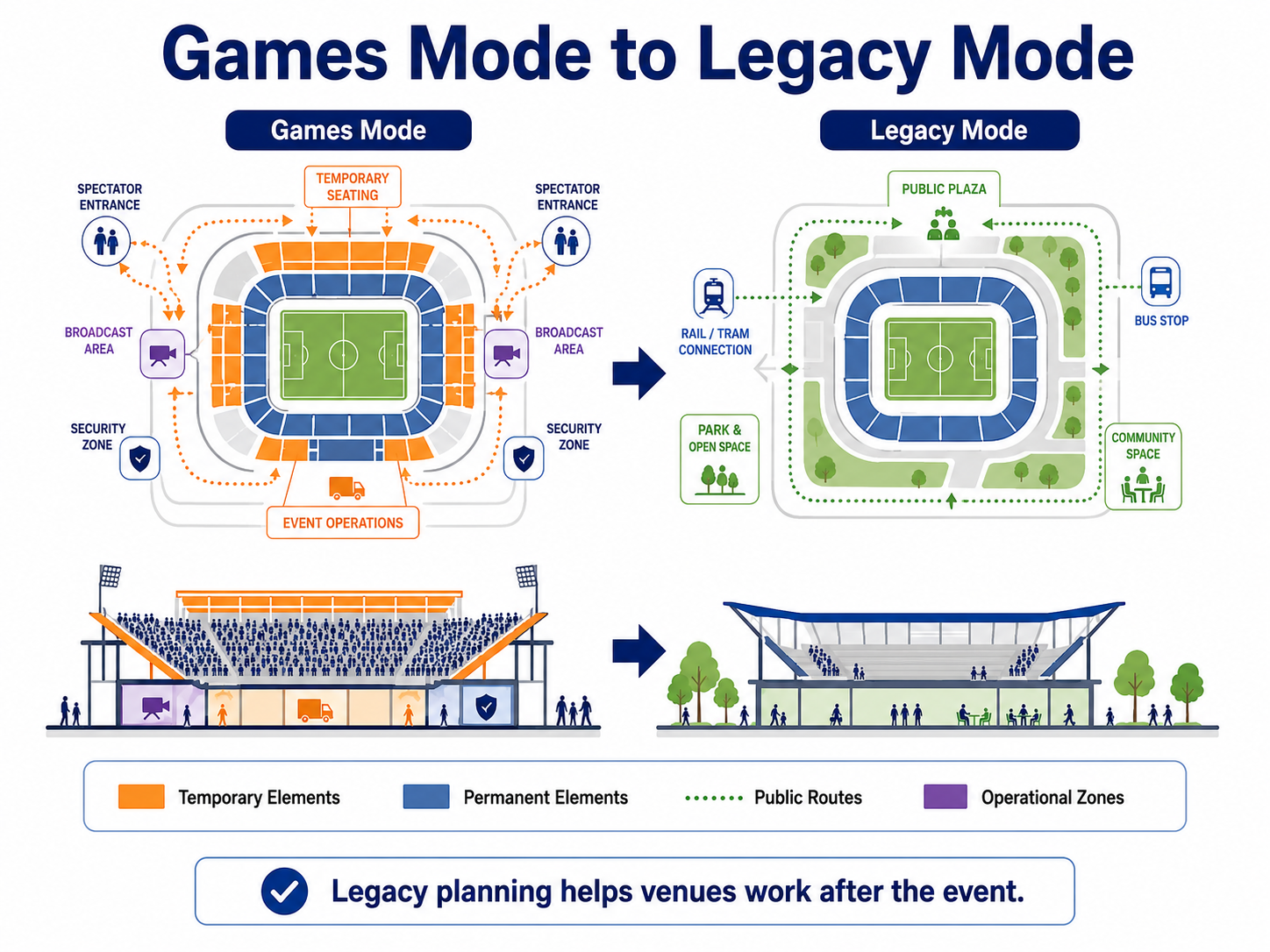
Games Mode to Legacy Mode
Hillsborough: Why Stadium Engineering Carries Life-Safety Consequences
Any serious discussion about stadium design should acknowledge Hillsborough.
The Hillsborough disaster was a fatal crowd crush at Hillsborough Stadium in Sheffield during the FA Cup semi-final between Liverpool and Nottingham Forest on 15 April 1989. Ninety-seven people ultimately died as a result of the disaster. The inquests later found that the victims were unlawfully killed and that supporter behaviour did not contribute to the tragedy.
For engineers, Hillsborough remains one of the clearest reminders that stadium safety depends on more than structural stability and that the ultimate consequence decisions of engineers can have. The disaster was not caused by a single structural collapse but arose from a chain of failures involving stadium layout, crowd capacity, safety certification, police planning, crowd control and emergency response.
The Leppings Lane terrace was central to the disaster. The terrace was divided into pens by fencing, and supporters entering through the tunnel were directed towards the central pens. When an exit gate was opened to relieve congestion outside the ground, too many people moved into the same already crowded area. The infrastructure did not allow the crowd to spread safely across the terrace.
Later investigations and reporting identified serious concerns with the safe capacity calculations for the Leppings Lane end. The Independent Office for Police Conduct noted that capacity had not been properly reassessed after changes to the terrace layout, even though those changes affected how much space was available to spectators. This meant the stadium’s safety assumptions did not properly reflect the real conditions inside the stand.
Several physical features made the situation more dangerous. The pen layout restricted lateral movement. The tunnel encouraged people into the central pens. The fencing limited escape. The crush barriers and their arrangement were later scrutinised as part of the wider assessment of stadium safety. Poor signage and crowd routing also made it harder to direct supporters towards less crowded areas.
The engineering lessons learnt from this tragedy is strong. A stadium is a system, not a collection of separate parts.
Capacity calculations, entry routes, barriers, signage, sightlines, gradients, stewarding positions, escape routes and emergency access must work together under pressure. A terrace, concourse or stand may appear manageable in normal use, but the real test is how it behaves when arrival patterns change, crowd density increases or control measures fail.
Hillsborough also shows why safe design cannot rely on optimistic assumptions. If a crowd route funnels people towards danger, the design has created a vulnerability. If a safe capacity is overstated, every operational decision based on that figure becomes weaker. If signage, layout and stewarding do not help people spread out safely, the crowd can become trapped by the very infrastructure intended to manage it.
For engineers, the lesson is sobering but necessary. Public safety depends on the details being right. It also depends on engineers, operators, authorities and event managers understanding how those details interact in real conditions.
Stadium design carries life-safety consequences. Hillsborough remains a permanent reminder that the people using infrastructure are not theoretical occupants on a drawing. They are real people, with families, histories and futures. The duty to design, assess and manage venues properly is therefore a profound professional responsibility.
Vibration and Residential Comfort
Some engineering impacts are felt quietly.
Vibration is one of them.
A building can be structurally safe while still performing poorly for the people inside it. A floor may carry the required load but feel uncomfortable. A residential block near a railway may satisfy high-level planning requirements but still expose occupants to disturbance if vibration is poorly assessed. A stadium stand may be safe but create discomfort if crowd movement causes excessive dynamic response.
People experience structures through use. They notice movement, sound, comfort and confidence. They notice whether a home feels restful. They notice whether a footbridge feels unsettling. They notice whether a building feels solid.
This is why serviceability matters. Civil and structural engineers must think beyond ultimate strength. Safety is fundamental, but human comfort is also part of responsible design.
In residential settings, vibration can come from railways, roads, plant, gyms, footfall, building services, neighbouring uses or construction activity. The response may involve structural stiffness, damping, isolation, layout changes, foundation design, separation distances, resilient mounts or operational controls.
These decisions affect people who may never know an engineer was involved.
A resident does not need to understand dynamic analysis to deserve a comfortable home. A buyer should not have to discover after occupation that a gym below their flat was poorly isolated. A family living beside infrastructure should not carry the burden of a missed assessment.
Good design uses appropriate standards, guidance and specialist input. It also requires clear communication. Engineers need to explain risks in a way that clients, architects, planners and contractors can understand. Technical issues that affect future users should not be hidden in dense reports that only specialists can follow.
Vibration is a good example of professional maturity because it tests whether an engineer can think about lived experience. It requires a link between calculation and human consequence.
For chartership candidates, this type of evidence can be powerful. It shows technical competence, risk awareness, communication and public-interest thinking. It also shows that the engineer understands the difference between making a structure stand up and making it work well for people.
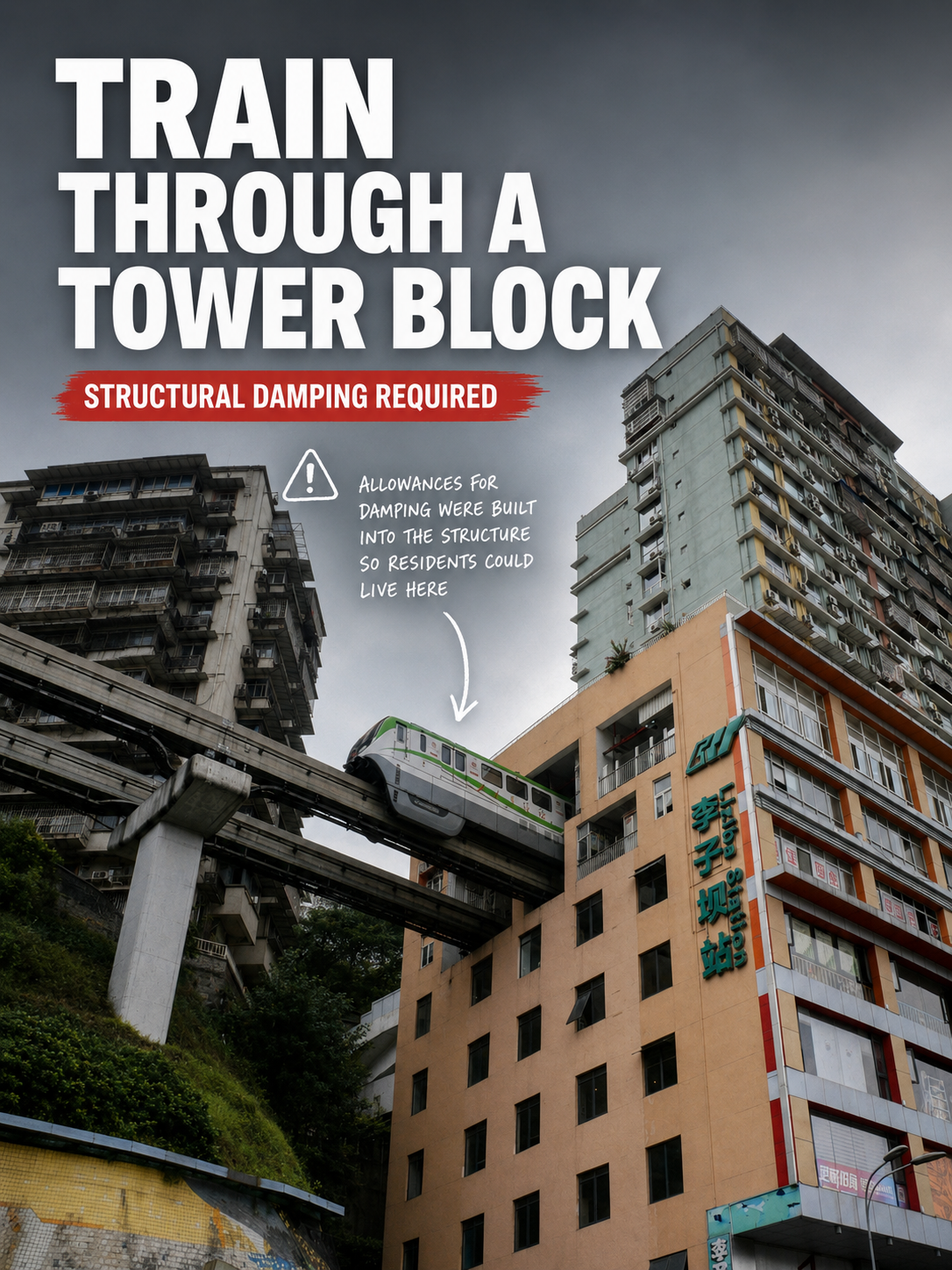
Damping in buildings
SuDS and Drainage: Helping People Downstream
Drainage and flood risk engineers often design for people outside the red line boundary.
Rainfall does not respect ownership boundaries. Water moves across roofs, gardens, roads, gullies, pipes, swales, basins, streams and rivers. A decision on one site can affect flood risk, water quality and amenity elsewhere.
This makes SuDS one of the clearest examples of engineering for strangers.
Sustainable Drainage Systems manage surface water closer to where it falls. They slow runoff, store water, encourage infiltration where suitable, improve water quality, and create opportunities for biodiversity and amenity. CIRIA’s SuDS Manual sets out the importance of designing for water quantity, water quality, amenity and biodiversity together.
The best SuDS schemes do more than satisfy a drainage calculation.
Rain gardens can intercept runoff from roofs and paved areas. Permeable paving can reduce runoff from driveways and roads. Swales can carry water visibly and slowly through a site. Detention basins can store water during storms. Retention ponds and wetlands can create habitat, improve water quality and provide attractive places for residents to walk around.
These features bring practical and human benefits.
A pond in a housing development may be part of the drainage strategy. It may also become a place where people walk after work, take children to look for wildlife, or choose a quieter route through the neighbourhood. A rain garden may reduce pressure on the drainage network while improving the appearance of a street. A permeable driveway may make a small contribution to reducing runoff, which becomes meaningful when repeated across many homes.
This is the cumulative nature of SuDS.
One rain garden does not solve a catchment problem. Many small, well-designed interventions across a catchment are best suited to reduce pressure on traditional piped systems, improve water quality and reduce flood risk. The beneficiaries may be downstream residents, future homeowners, local wildlife, water companies, local authorities and communities affected by extreme rainfall.
The engineer may never meet them.
Design quality is critical. Poorly designed SuDS can become blocked, unsafe, unattractive or difficult to maintain. Good SuDS need suitable levels, safe exceedance routes, appropriate planting, maintainable inlets and outlets, clear ownership, sediment control, and realistic access for maintenance.
The four pillars of SuDS help prevent narrow thinking.
Water quantity deals with runoff rate and volume. Water quality deals with pollutants and treatment. Amenity deals with how people experience the place. Biodiversity deals with habitat and ecological value. A strong scheme considers all four from the start.
For engineers, SuDS design is a useful reminder that drainage drawings shape public space. A basin, swale or rain garden is not only a hydraulic feature. It is part of the place people inherit.
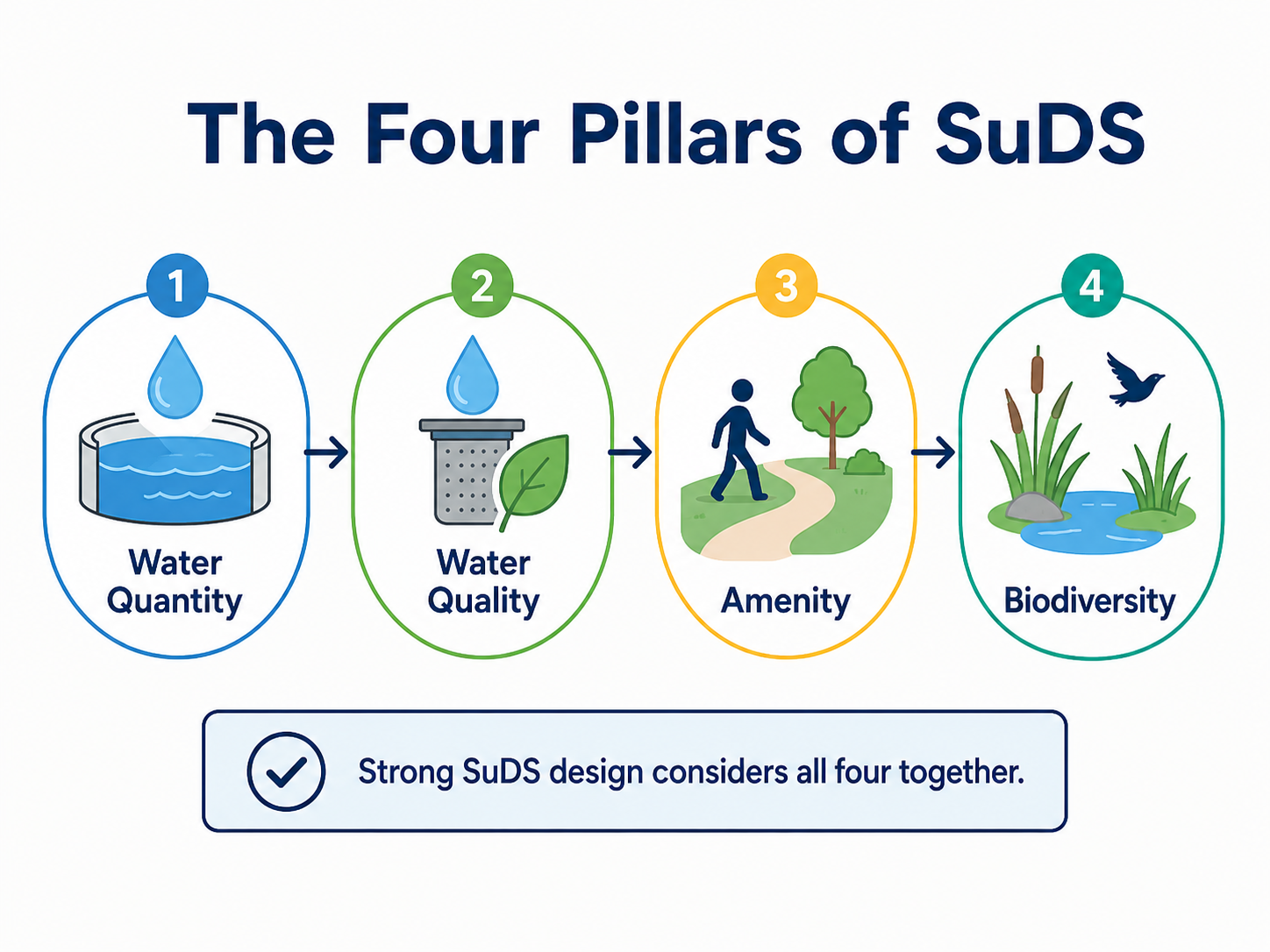
The Four Pillars of SuDS
Major Infrastructure and the Hidden Work Behind Public Benefit
Major infrastructure can feel distant from ordinary life because the scale is so large.
Power stations, rail projects, reservoirs, ports, tunnels and flood schemes involve thousands of people, long programmes and complex supply chains. The public often sees the cost in the news, the politics, the visual impact and the final opening. They rarely see the detailed engineering decisions that make delivery possible.
Hinkley Point C and Sizewell C are useful examples.
Hinkley Point C is under construction in Somerset and is expected to provide low-carbon electricity for around six million homes. Sizewell C in Suffolk has been promoted as a major new nuclear project that will also provide reliable low-carbon electricity for around six million homes and support thousands of jobs during construction.
Those headline benefits depend on detailed engineering at every level.
Major nuclear construction involves a significant amount of engineering; permanent works, temporary works, earthworks, concrete, reinforcement, marine works, logistics, heavy lifting, access systems, design coordination, quality assurance, environmental controls and strict safety management to name but a few. The public benefit depends on thousands of technical decisions being made carefully.
Temporary works are a major part of this story.
They are often removed before the public ever sees the completed asset. Their importance is immediate. They protect workers, support partially complete structures, enable access, manage construction loads and allow permanent works to be built safely.
A temporary support frame, platform, propping system, cofferdam, lifting arrangement or access structure may exist for only part of the programme. During that period, it must perform properly. It must be designed, checked, installed, inspected and used correctly.
This work may feel invisible, but it carries serious responsibility.
Large projects also require careful coordination between disciplines. Temporary works must interface with permanent works. Construction sequencing must reflect real site constraints. Procurement must align with design requirements. Fabrication drawings must be checked. Technical queries must be answered. Field changes must be assessed against load paths, tolerances and safety assumptions.
An engineer working on one package of work may feel far removed from the eventual public outcome. That feeling can be misleading. A drawing review, calculation check, site inspection or technical query response can affect safety, programme, quality and long-term performance.
The public may describe the finished asset as a power station, railway, bridge or flood scheme. The asset is also the result of thousands of disciplined engineering actions.
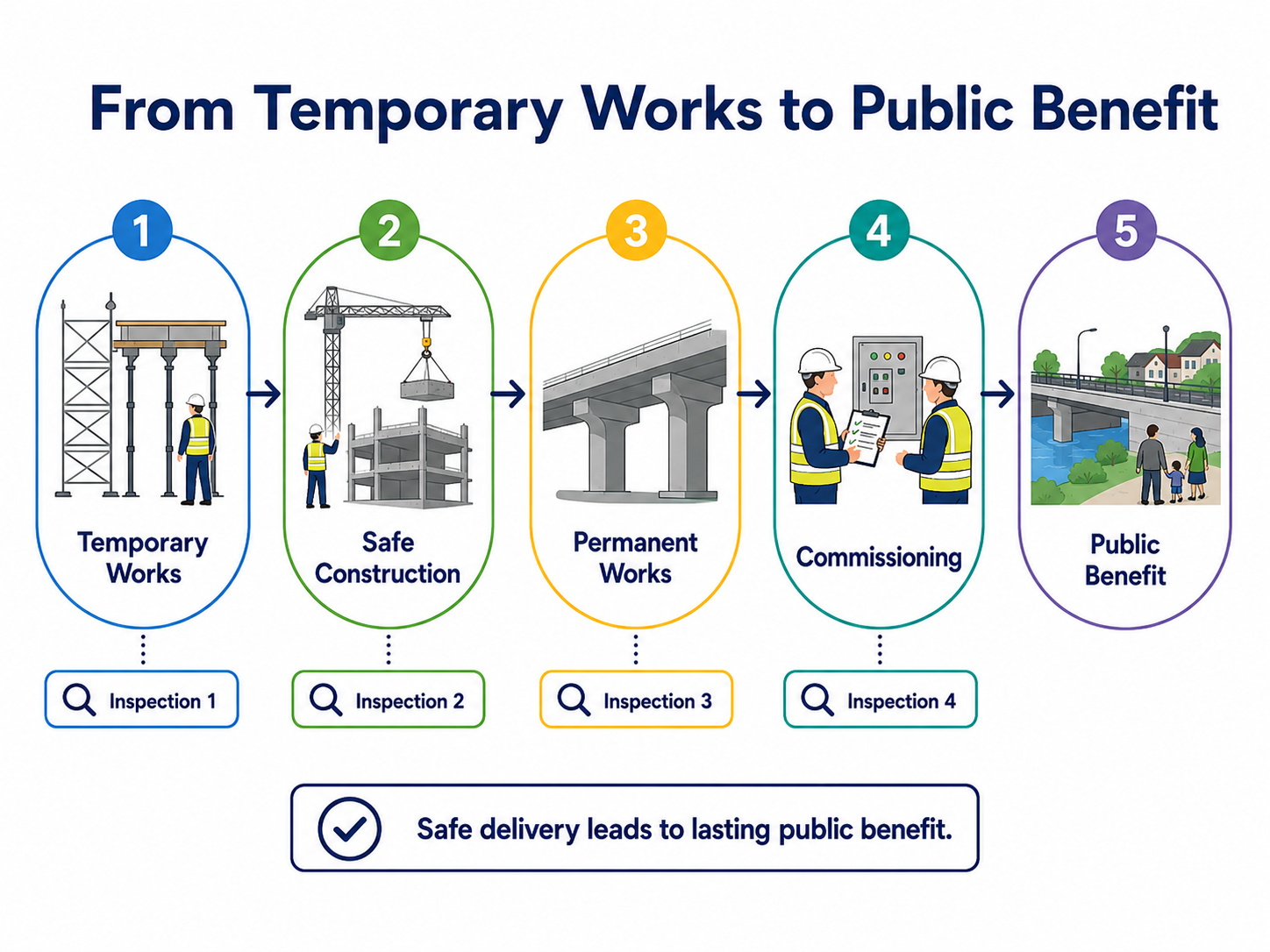
From Temporary Works to Public Benefit
Inclusive Design and the Role of Guidance
Designing for people you will never meet requires disciplined imagination.
Engineers must consider users with different abilities, ages, confidence levels, cultural backgrounds and levels of familiarity with the place. They must think about children, older people, disabled users, maintenance teams, emergency services, residents, visitors and future operators.
Good design should not depend on every user being confident, fit, local, technically aware or able to interpret poor layouts.
This is why inclusive design matters.
In practice, inclusive design affects gradients, surfacing, lighting, crossing points, drainage details, wayfinding, tactile information, seating, access widths, maintenance routes, emergency access and public realm layout. It also affects how engineers respond to community knowledge.
Local communities often understand things that drawings do not show. They know which paths people actually use. They know where flooding occurs. They know where lighting feels poor. They know where traffic feels unsafe. They know which spaces are avoided after dark.
Engineers should take that knowledge seriously.
Standards and guidance help engineers make better decisions. They capture lessons from research, past projects, failures, user needs and professional experience. They give structure to decision-making and help teams avoid relying only on personal judgement.
However, guidance needs understanding. A clause should be applied with awareness of its purpose. A standard detail should be checked against the real site. A design should satisfy the underlying public need, not only the minimum wording.
For engineers, this is one of the signs of professional growth. Mature engineers do not simply ask, “What does the standard say?” They also ask, “What risk is this standard trying to manage?” and “Will this work for the people who will use and maintain it?”
This approach strengthens design quality. It also supports chartership evidence because it shows judgement, responsibility and awareness of the wider public interest.
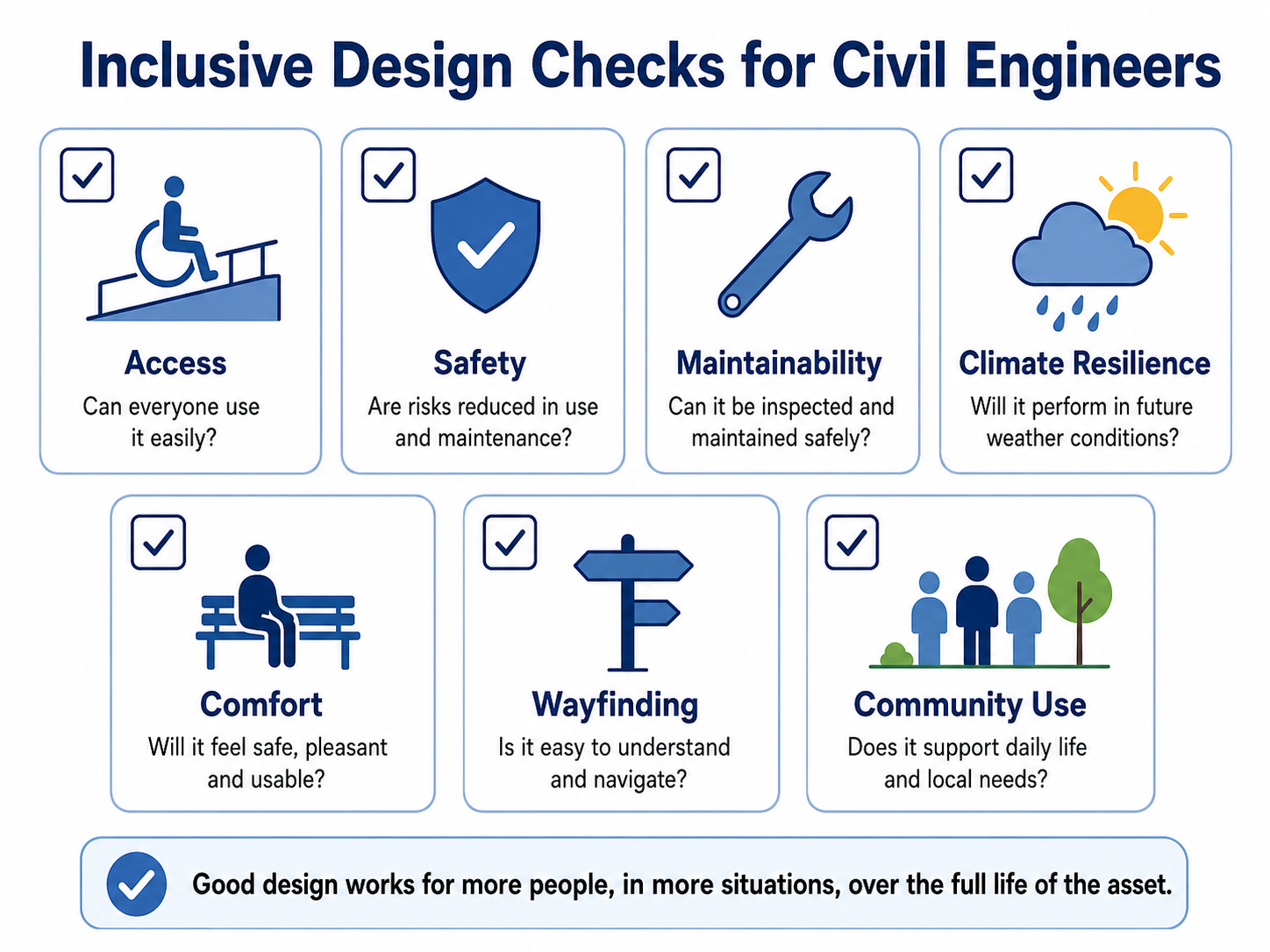
Inclusive Design Checks for Civil Engineers
Professional Responsibility in Everyday Decisions
Engineering responsibility often appears in ordinary project moments.
It appears when an engineer questions an assumption rather than passing it forward. It appears when a drainage designer checks where exceedance flows will go. It appears when a structural engineer raises a vibration concern early enough for the layout to change. It appears when temporary works are checked properly. It appears when a designer explains risk clearly to a client who is focused on cost.
These moments may not feel dramatic. They are the fabric of professional practice.
Civil engineers are trusted because society cannot personally check every calculation, specification or inspection. The public relies on the profession to act with competence and integrity. That trust has to be earned through careful work.
This is especially relevant to engineers at all levels.
You do not need to be a project director to make decisions that matter. You can take ownership of the task in front of you. You can understand the end user. You can apply guidance properly. You can ask clear questions. You can record assumptions. You can communicate risk. You can think about maintenance, climate, safety and public value.
Small pieces of judgement accumulate into large public outcomes and that is the profession.
Conclusion
Civil engineers design for people they may never meet.
A stadium visitor depends on safe crowd movement, clear routes and suitable long-term planning. A resident depends on good structural and vibration decisions. A downstream community depends on drainage engineers who understand catchments, exceedance routes, SuDS and maintenance. A national energy system depends on major infrastructure teams who manage permanent works, temporary works, safety, quality and delivery with discipline.
The best engineering is safe, useful, maintainable, inclusive and robust. It is based on guidance and standards that are well researched, properly understood and applied with judgement. It recognises that infrastructure belongs to the people who use it, including people who will never know who designed it.
For engineers working towards chartership, this is a strong way to think about professional competence. The ICE attributes are ultimately about applying engineering skill in service of society. They ask whether you can manage risk, communicate clearly, act ethically, lead effectively and contribute to sustainable outcomes.
Designing infrastructure for people you will never meet is one of the clearest expressions of that responsibility.
If this article helped you think differently about civil engineering practice, explore more Civil Engineered for Success blog articles, share your thoughts in the comments, or connect with the Civil Engineered for Success community for further insights.
Subscribe to the newsletter to stay sharp, informed and inspired.
References
Institution of Civil Engineers, “London 2012 Games”https://www.ice.org.uk/what-is-civil-engineering/infrastructure-projects/the-london-2012-games
Independent Office for Police Conduct, “The safety of Hillsborough Stadium”https://www.policeconduct.gov.uk/hillsborough-report/chapter-2/safety-hillsborough-stadium
GOV.UK, “Determinations and findings of the Hillsborough inquests”https://www.gov.uk/government/speeches/determinations-and-findings-of-the-hillsborough-inquests
HSE, “Hillsborough Stadium incident 15 April 1989”https://www.hse.gov.uk/foi/releases/hillsborough.htm
The Guardian, “Hillsborough trial: engineers made gross error, says engineer”https://www.theguardian.com/football/2019/feb/05/hillsborough-trial-engineers-made-gross-error-says-engineer
CIRIA, “The SuDS Manual C753”https://www.ciria.org/CIRIA/CIRIA/Item_Detail.aspx?iProductcode=C753
EDF Energy, “Hinkley Point C”https://www.edfenergy.com/energy/nuclear-new-build-projects/hinkley-point-c
GOV.UK, “Sizewell C gets green light with final investment decision”https://www.gov.uk/government/news/sizewell-c-gets-green-light-with-final-investment-decision
GOV.UK, “Thousands of jobs to be created as government announces multi-billion-pound investment to build Sizewell C”https://www.gov.uk/government/news/thousands-of-jobs-to-be-created-as-government-announces-multi-billion-pound-investment-to-build-sizewell-c
CIRIA, “The SuDS Manual C753F”https://www.ciria.org/CIRIA/Books/Free_publications/C753F.aspx