
Why Infrastructure Decisions Improve When the Team Is More Diverse
Introduction
The best infrastructure decisions do not always come from the most qualified person in the room, but from the most complete picture of the problem.
Infrastructure planning runs on assumption, assumptions on who uses a system, how they behave, how much demand they place on it, and when. Those assumptions almost always reflect the experience of whoever built the model. And if that group of people is broadly similar in background and outlook, the assumptions will be too.
That clearly is not a criticism of any individual’s ability, but an observation of how design decisions are made, and how easily reasonable assumptions can shape outcomes in ways that are never revisited.
In infrastructure, those assumptions do not stay on paper. They set design parameters, influence investment decisions, and ultimately determine how systems perform in the real world. Thisn however, becomes a problem when those assumptions go unchallenged, because they directly shape what gets built and how well it performs.
1. The Assumption Problem
The first example of this being a problem is water demand forecasting. Standard practice applies a per capita consumption figure, typically 135 to 145 litres per person per day for UK domestic users, as the design basis [1]. It is a strong starting point. Widely used, well understood and well documented.
But in London, that value hides a large variation.
Studies on water use across London and the Thames Valley show that actual demand per person varies significantly by household size, occupancy density, dwelling type, and cultural practice [2]. Households where religious washing is carried out under running taps can add 30 to 60 litres per person per day above the standard figure [1]. Multi-generational households have a fundamentally different total demand profile to the single-occupancy flats most city models are built around. South Asian-headed households show different consumption patterns even after controlling for household size [3].
If nobody in the planning team has thought to question whether the standard figure fits the actual population, you get infrastructure designed for an average that doesn’t really exist. Undersized networks. Demand management programmes that miss the communities they are aimed at and interventions that simply don’t work
This comes down to perspective, not capability.
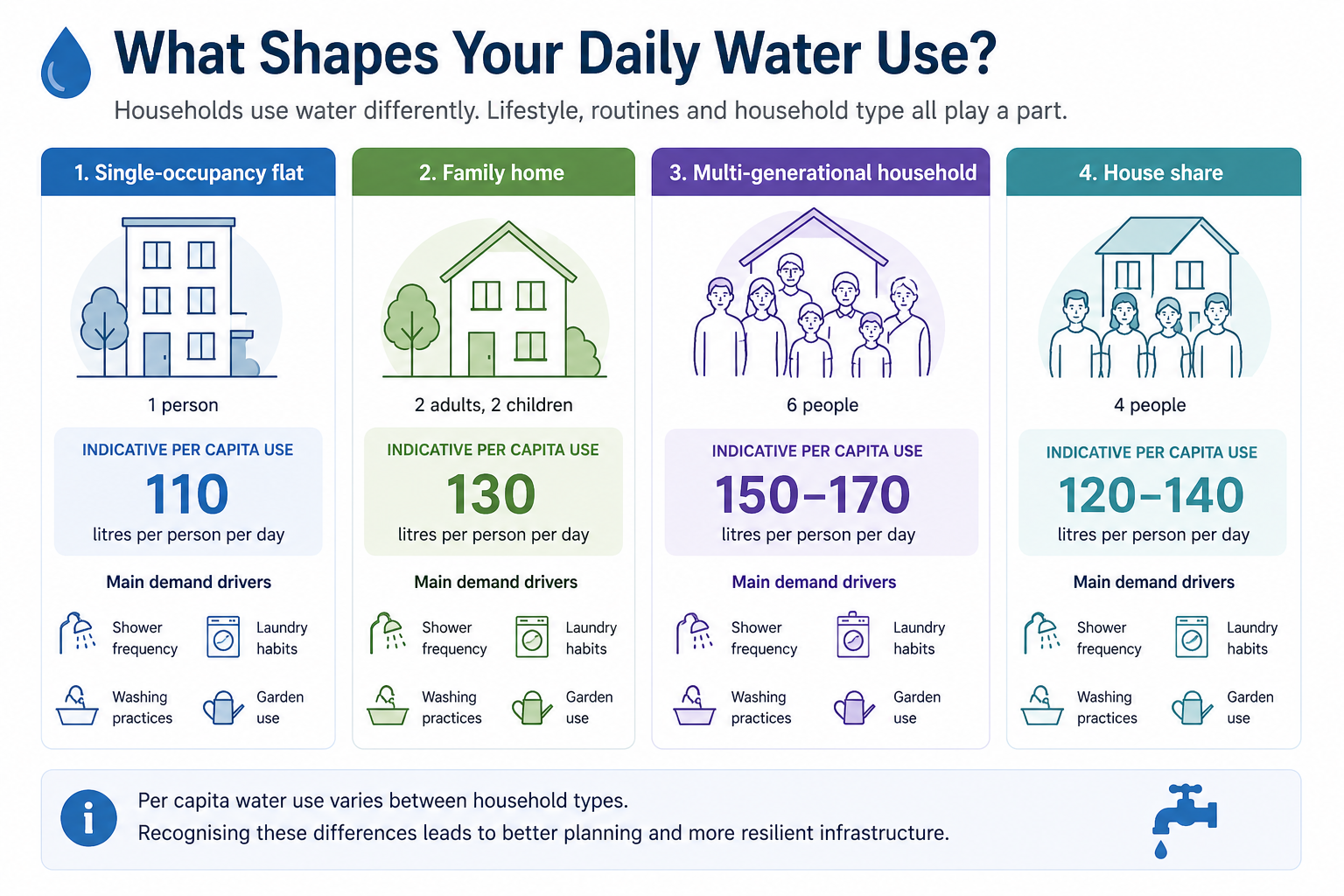
What Shapes Your Daily Water Use?
2. What the Research Shows
The evidence on this is strong.
McKinsey's large-scale research found that gender-diverse companies are approximately 25% more likely to achieve above-average profitability, and ethnically diverse ones 36% more likely [4]. The link is to decision quality and execution, not culture or morale. In engineering teams specifically, diverse groups consistently outperform homogeneous ones on problem-solving, risk identification, and delivery [4].
Harvard Business Review's work on senior leadership teams found that cognitively diverse teams, where people genuinely think differently and approach problems differently, solve complex challenges faster, especially under time pressure [4]; which is the business as usual environment for infrastructure planning.
Three things explain why.
Diverse teams look at more options. Different backgrounds and problem-solving approaches generate a wider solution space and reduce the tendency to anchor on the first workable idea [4]. Better optioneering. Fewer missed solutions.
They challenge assumptions more readily. Teams where everyone thinks alike tend to reinforce each other's assumptions under pressure whereas cognitively diverse teams are more likely to question what is being taken for granted [4]. In a discipline where assumptions about demand, climate, and population behaviour drive design decisions, that is a meaningful advantage.
They spot risk more effectively. Engineering and construction research consistently links diverse teams to stronger risk assessment and more robust project planning [4]. On projects where getting risk wrong costs millions, the difference is significant.
3. What Changes When You Bring in Different Perspectives
Barcelona's Superblocks programme is a clear example.
In the Eixample district, residents were involved in shaping a programme that reallocated road space away from vehicles and towards people. The design was iterated based on what consultation from the communities living in the immediate areas showed, and not the designers or policy[5]. The starting assumption had been that vehicle throughput was the primary design objective. Community engagement revealed that local residents' actual priorities were quieter streets, play space, and active travel [5]. That changed the entire design response: filtered traffic layouts, expanded pedestrian areas, and social space rather than minor traffic calming [5].
The technical team was not lacking competence. They were just lacking the perspective to question the right assumption. It took a broader range of voices to surface it.
The water and drainage parallel is direct. Research on urban water resilience consistently finds that governance and community engagement matter as much as the engineering itself, because user behaviour and local priorities determine how systems perform under stress [6]. Climate resilience initiatives increasingly treat inclusive stakeholder engagement as a core part of adaptation planning, not an afterthought, because local knowledge improves risk identification and the implementation of measures [6].
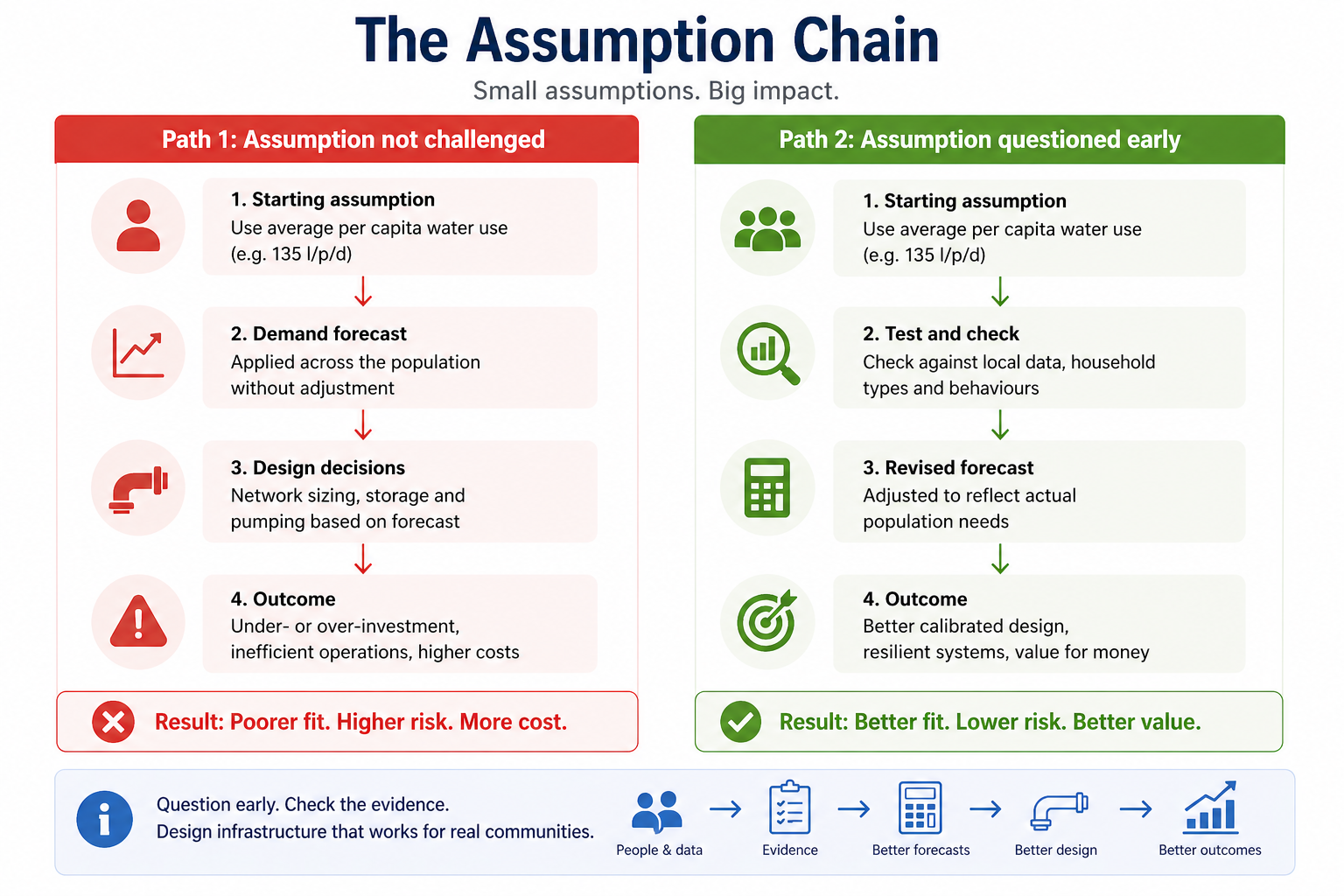
The Assumption Chain
4. Why London Illustrates This Particularly Well
London highlights a basic issue in infrastructure planning.
There is no single “average” household.
London, being one of the most diverse cities in the world [8] has no ethnic majority, and its boroughs vary widely in age, household size, and how people live [3]. At the same time, the population is growing fast, which puts increasing pressure on water, drainage, and wider infrastructure [3].
Planning policy is starting to reflect this. The London Plan and water companies now look at household size, occupancy, and demographic variation, rather than relying on one standard figure [3]. New homes are designed to use 105 litres per person per day, well below current levels, because a single assumption does not work [1].
But in practice, the idea of an “average” is still widely used.
Typical UK water use is often quoted at around 135 to 145 litres per person per day. In reality, the spread is much wider. Some households use closer to 100 litres per person per day, while others exceed 170 litres. The difference often comes down to behaviour and daily routines.
For example:
Larger households tend to use less water per person, but more overall
People at home during the day use more water
Shower length, laundry habits, and routine choices can shift use by tens of litres
Cultural and faith practices can also increase or reduce demand depending on how water is used
So the “average” hides what actually matters.
Two similar developments in London can have very different water demand, even if they have the same number of homes and occupants. It depends on who lives there and how they live.
If design is carried out around a single number, this variation is missed and London shows that clearly.
5. What This Means in Practice
Civil engineering is not just about calculations, standards, or models but bringing in deep understanding of how things work in the real world, how people live and how systems are used. The best engineers do not take inputs at face value. They question them, test them, and recognise where simple assumptions hide real risk.
When you show that you understand the human context of infrastructure, that you have considered how different groups will use what you design, and that you have challenged your own starting point, you are demonstrating proper engineering judgement.
That is what separates a competent engineer from an exceptional one.
In day-to-day work, it comes down to a few practical habits.
When reviewing demand assumptions, ask where the numbers came from and whether they reflect the population you are designing for. In optioneering workshops, notice whether the same voices are driving the conversation. When engaging with communities or stakeholders, treat what they tell you as technical input, not background colour.
The risks of applying average demand assumptions without scrutiny are well documented. Infrastructure designed around a single mean forecast can be undersized if growth outpaces assumptions, or heavily over-capitalised if conservation succeeds beyond expectation [7]. Questioning those assumptions early, which is far more likely in a diverse team, is one of the most effective risk management tools available.
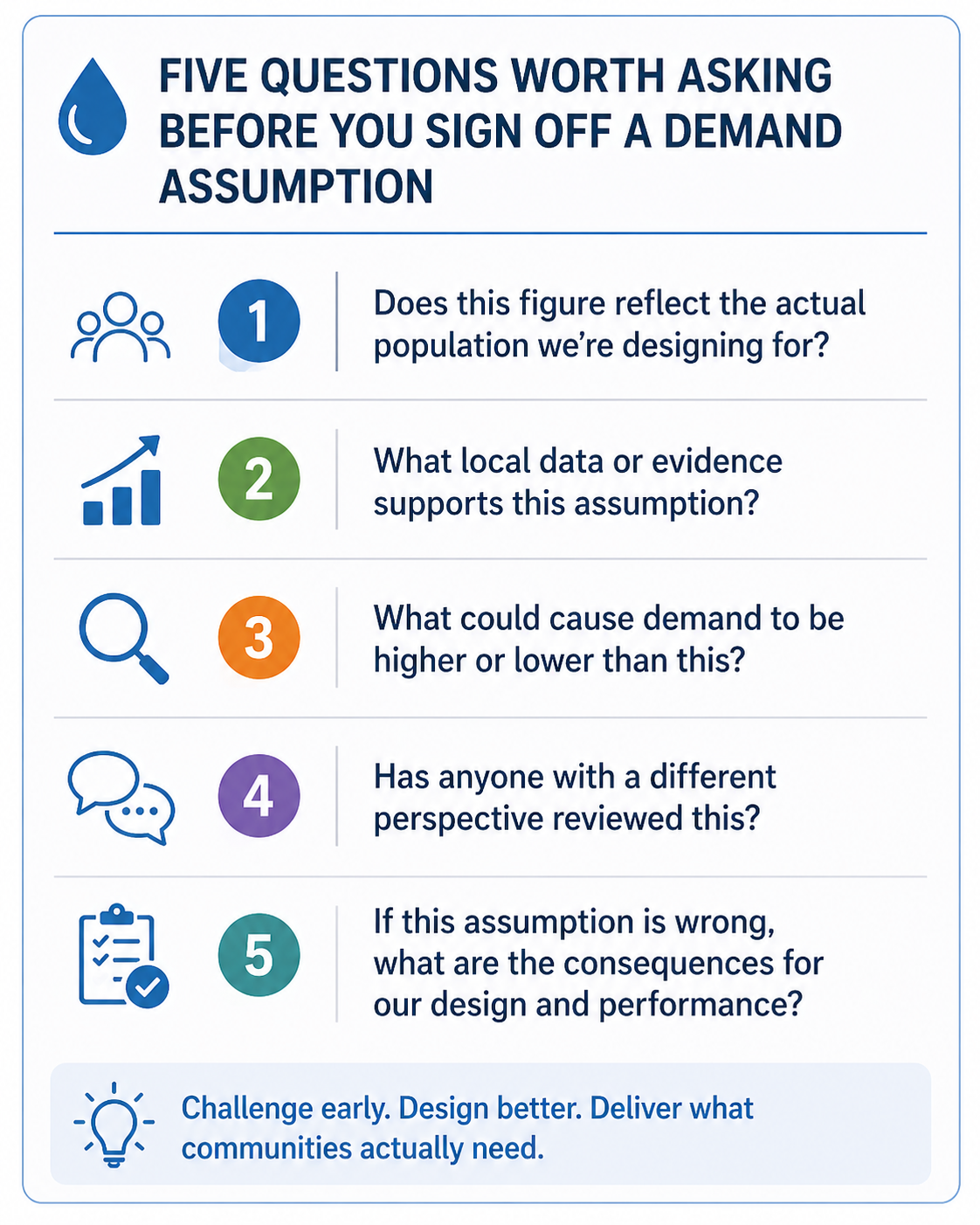
Five Questions Worth Asking Before You Sign Off a Demand Assumption
Conclusion
The case for diverse teams in engineering is a performance argument. Diverse and cognitively varied teams make better decisions, explore more options, challenge assumptions more readily, and identify risks more effectively. In infrastructure, where the consequences of getting those things wrong play out over decades, that matters.
The evidence from water demand research, climate resilience work, and projects like Barcelona's Superblocks all points in the same direction. Bring broader perspectives in early and you are more likely to build something that actually works for the people it serves.
As engineers, you can start building this into how you work right now. Question your assumptions. Notice who is not in the room. Treat demographic and cultural context as data, not background detail.
That is what good engineering judgement looks like.
References
[1] Thames Water and London Assembly. Per capita consumption data and London Plan 105 l/p/d policy target. Available at: https://www.london.gov.uk/who-we-are/what-london-assembly-does/questions-mayor/find-an-answer/water-use
[2] Compiled UK domestic water use evidence: Cladco, South Staffs Water, Waterwise. Variation in PCC by household type, occupancy, and behaviour.
[3] Greater London Authority. The London Plan 2021, Policies D1, D3, D6. Household size, density, water efficiency, and infrastructure capacity. Available at: https://www.london.gov.uk
[4] McKinsey & Company; Harvard Business Review; Engineering Management Institute. Cognitive diversity, decision quality, and risk management in engineering teams. Available at: https://www.ilxgroup.com/usa/blog/the-importance-of-cognitive-diversity-in-workplace-teams
[5] Barcelona Superblocks community engagement case study. Available at: https://www.linkedin.com/pulse/case-studies-successful-infrastructure-projects-prioritize-community-j7qhc
[6] SSOAR Urban Planning. Enhancing Water Infrastructure Resilience, 2025. Available at: https://www.ssoar.info/ssoar/bitstream/handle/document/105369/ssoar-up-2025-adu-Enhancing_Water_Infrastructure_Resilience_in.pdf
[7] Artesia Consulting WRMP demand scenario work; iwaponline peak vs average demand research. Available at: https://www.artesia-consulting.co.uk
[8] World Population Review, https://worldpopulationreview.com/world-city-rankings/most-diverse-city-in-the-world
Join the Conversation
If this was useful, there is more on the Civil Engineered for Success blog covering chartership, technical practice, and career development. Drop your thoughts in the comments, share it with someone who would find it relevant, and if you are not already subscribed to the newsletter, this is a good moment to change that.
Every issue is built to keep you sharp, informed, and a step ahead.
Subscribe to Civil Engineered for Success.